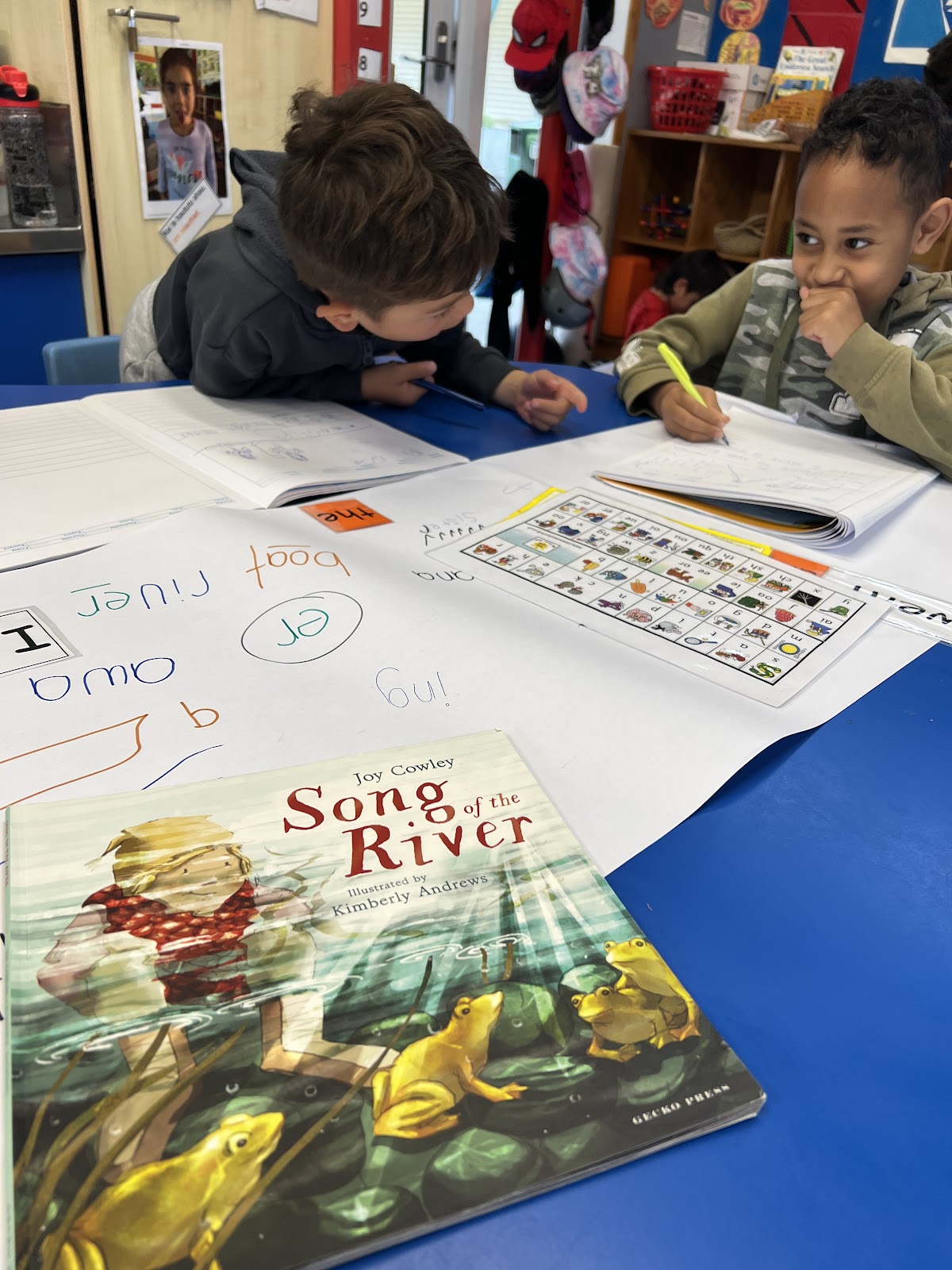
I don't believe in taking a group out so my observation is quiet and therefore contrived - this is what I deal with. I don't do writing lessons on the daily in isolation. You will here me directing and re-directing Rihari again and again.
The provided text outlines a teacher's professional plan to enhance the literacy skills of a specific group of Year 1 students through structured interventions. The primary focus is shifting from oral-only phonics to simultaneous orthographic mapping, which reinforces the connection between sounds and letters to improve reading fluency. For writing development, the educator is implementing visual rubrics and picture plans to foster student independence and self-reflection. These tools are designed to demystify academic expectations and reduce cognitive overload by providing clear, manageable steps for sentence construction. Ultimately, the source details a strategic approach to accelerating student progress by aligning classroom practices with research-based curriculum standards.
Assessment of Your Inquiry Goals and Practice
1. Strategic Alignment of Goals and Method
Addressing Independence and Interruptions: You identified that your top writing group can produce two sentences but struggles with independence on the second sentence, leading to frequent interruptions while you teach other groups. Your design of a visual/emoji-based writing rubric directly addresses this hurdle by providing a self-made checklist and peer-reflection tool.
Scaffolding Writing Mechanics: Your rubric focuses on key foundational mechanics: starting with a capital letter, ending with a full stop, leaving spaces between words, sounding out dominant phonemes, and using alphabet card references. Paired with your trial of a two-part picture plan, this gives children a structured roadmap to organize and execute two sentences independently.
Building Student Agency: Incorporating "goal-oriented talk" (helping tamariki articulate what was "tricky" and what "helped") directly fosters reflective learning and builds their identity as capable writers.
Next Steps for Foundational to Year 1 (Phase 1 Curriculum Alignment)
To keep progressing your top writing group through Phase 1 (Years 0–1) of the new curriculum and align with the Year 1 Proficient rubric benchmarks, consider these targeted next steps:
1. Writing Processes (Planning & Self-Editing)
Oral Sentence Planning: Explicitly guide tamariki to determine and recite the precise wording of each sentence out loud before writing.
Independent Rereading & Checking: Continue embedding the visual rubric until tamariki routinely reread their text to check for capital letters, full stops, and known spelling patterns as they write.
Reflective Communication: Consolidate goal-oriented talk by prompting tamariki to use comparative and explanatory language (because, so, easier than) when reflecting on their writing progress.
2. Transcription & Orthographic Mapping
Full Phonemic Segmentation: Transition students from identifying initial sounds to orally segmenting all three phonemes (first, middle, and last) in CVC words and connecting them immediately to print using simultaneous mapping.
Digraphs and Adjacent Consonants: Secure Kākano 3 consonant digraphs (e.g., <sh>, <ch>, <th>, <ng>) and CCVC/CVCC words to push spelling approximations toward greater automaticity.
3. Composition & Sentence Structure
Connecting Ideas: Support capable writers to move from basic simple sentences toward using coordinating conjunctions (and, but, so) to build compound sentences.
Expanding Purpose: Apply the two-part picture plan across multiple writing purposes outlined in the Year 1 sequence—such as writing to entertain (sequential events), inform (main idea with supporting details), or express an opinion ("I think...").
💡 If you'd like, I can help you compile a structured mini-lesson plan or a printable two-part picture plan layout incorporating these Year 1 curriculum prompts for your top group.
Please give me a lesson evaluation and next steps in my practice
Lesson Evaluation: Have You Achieved Your Inquiry Goal?
Based on your lesson transcript [188–198] and reflective goals [1–9], you have successfully implemented the core scaffolds, though student independence is still in the transition phase.
1. What You Achieved
Successful Two-Sentence Production: Your top group writers successfully composed and transcribed two distinct sentences (e.g., "I am at my house. We are watching TV.").
Explicit Oral Planning: You embedded oral sentence planning directly into the lesson before writing began ("Say your sentence out loud — what was it again?"), which aligns directly with Phase 1 Year 1 curriculum expectations.
Active Use of Reference Tools: Tamariki actively utilized the high-frequency word cards (e.g., locating "my" in the yellow box) and turned to the alphabet cards for consonant digraphs like <ch> ("beach") and <sh> ("shop").
Checklist/Rubric Familiarization: You explicitly walked students through the visual/emoji writing checklist (picture plan, capital letters, finger spaces, sounding out, full stops, and sense-checking).
2. Where Practice is Still Developing
Teacher Dependency During Assessment: In the transcript, you led the checklist evaluation step-by-step ("Did you start with a capital? All yes, you did. Did you use finger spaces? Oh yes..."). As you noted in your reflection, this scaffolded modeling is a necessary first stage before students can self-assess or peer-check independently.
Picture Plan Fidelity: One student wrote two sentences but skipped drawing the second picture plan. Ensuring tamariki draw both pictures first ("First and then") remains essential for keeping them visually anchored while you teach other groups.
Student Agency & Reflective Talk: While you checked off criteria, the tamariki were not yet invited to articulate what was tricky or what helped them during the writing process.
Next Steps for Phase 1 (Year 1 Curriculum Alignment)
To move students from teacher-guided completion to true independence and align with Year 1 Proficient benchmarks, consider these four targeted next steps:
1. Shift from Teacher-Led Checking to Student-Led Reflection
Self-Assessment Prompts: Instead of confirming items for them, hand the rubric over and prompt: "Show me where your capital letter is" or "Point to a word you had to sound out.".
Goal-Oriented Talk: Prompt tamariki using comparative/explanatory language (because, easier than) to explain what was challenging and which reference card helped them solve it.
Peer Checking: Once self-assessment is familiar, pair students to check each other's full stops and finger spaces before they bring their mahi to you.
2. Consolidate the Two-Part Picture Plan
Maintain the two-part picture plan as a non-negotiable planning step before writing. If a student tries to write without drawing Picture 2, redirect them to complete the visual outline first so their second idea is fully straight in their head.
3. Deepen Simultaneous Phoneme-Grapheme Mapping
Oral Segmentation: When students ask how to spell a word, prompt them to orally segment all phonemes in CVC/CCVC/CVCC words before writing, rather than supplying letter combinations directly.
Compound Sentences: Introduce coordinating conjunctions (and, but, so) during oral planning to support capable writers in connecting ideas.
Diverse Purposes: Apply the two-part picture plan across different Year 1 composition forms, such as writing to entertain (linked events), inform (main idea with details), or express an opinion ("I think..." / "I feel...").
MY THOUGHTS:
Next steps - maybe change up the rubric
To transition your tamariki from teacher-guided checking to genuine, student-led self-assessment, you can adapt both the physical layout of your visual rubric and the classroom routines around how students interact with it.
Here are four concrete ways to adapt the rubric and process for Year 1 self-assessment:
1. Add "Action-Based" Proofing Steps
In your trial lesson, you guided students through circling smiley/sad faces step-by-step. To make self-assessment an active habit rather than passive circling:
Physical Evidence Check: Require tamariki to physically mark or point to their evidence on the page before touching the rubric emojis:
Capital Letters: Highlight or trace the first letter of each sentence with a yellow crayon.
Finger Spaces: Touch pencil tips into the spaces between words to confirm they didn't write a continuous stream of text.
Ending Punctuation: Circle the full stops at the end of both sentences in color.
Laminated Self-Check Strips: Provide laminated, desk-mounted strips where students use dry-erase markers to tick off each box before coming to you.
2. Embed "Goal-Oriented Talk" Prompts
Your inquiry goal highlights using reflective communication so tamariki can articulate their learning process. The Phase 1 English Curriculum prioritizes teaching children to describe what was challenging, what helped, and what to do next [57–58].
You can adapt the bottom section of your rubric to include two simple visual speech bubbles for oral reflection before or during editing [3, 57–58]:
"What was tricky?"<i>(e.g., sounding out a word, remembering the second sentence)</i>.
"What helped me?"<i>(e.g., drawing my 2-part picture plan, checking the yellow HFW box, or using the alphabet card for digraphs like <sh> or <ch>)</i> [4, 57–58, 188, 193, 196].
Prompting students with explanatory sentence frames like "It was easier because..." or "I used my card to..." strengthens both their verbal reasoning and their agency as writers [47, 57–58].
3. Establish a "Self-Check Entry Ticket" Routine
To prevent student interruptions while you teach other small groups, make the completed self-assessment the non-negotiable "entry ticket" for bringing writing to you:
Reread for Sense: The student reads their two sentences out loud to themselves (or whispers into a whisper-phone) to check that the words make sense.
Mark the Rubric: The student marks their smiley/sad faces independently.
Targeted Edit: If they circle a sad face for a criterion (e.g., missing full stop), they must attempt to fix it independently before showing you.
As you noted in your lesson transcript, peer reflection is the natural next step once students understand the criteria.
The "Pass & Point" Partner Check: Pair tamariki in your top group. Student A reads their sentences out loud while pointing to each word (one-to-one matching) [82–83, 189]. Student B listens to check if it makes sense and checks for one specific rubric feature (e.g., "Show me your two full stops").
Peer Sign-Off: The buddy puts a small checkmark on the rubric before the writer brings their book to the teacher's table.
This is the rubric suggested by AI - not suitable excecpt for use by myself. I would have to turn it into a kid-speak one.
I felt supporting the tamariki with the rubric has worked really well and I can see that a move from self-reflection to peer reflection would work really well.




Comments
Post a Comment